Creativity can be as straightforward as finding a better way to join two parts of a treatment. It could show up in how you introduce an unfamiliar position, adapt a familiar sequence or make room for a recipient to settle. A competition gives you a particular setting in which to demonstrate such choices. It also gives you boundaries that can make it easier to decide which ideas belong.
Start with something about your work that matters to you. You might want an opening that feels calm and easy to understand, a flow that connects the treatment clearly, or a way to show respect for an approach you have studied in depth. A small, deliberate addition can be easier for a judge and a recipient to understand than a long demonstration of everything you can do.
Begin inside the category
Read the definition, permitted techniques and judging points for the specific edition. The IMA Copenhagen rules list innovation alongside technique, flow, ergonomics and client contact. They also make distinctions between named and freestyle categories. The National Massage Championship rules describe creativity and innovation in the context of the treatment and professional standards. These are invitations to develop an idea within the competition’s format. The names of the criteria do not give permission to use everything an organiser might find interesting.
The Canadian championship descriptions encourage participants to choose based on the approach that dominates the routine. That is a helpful question when a freestyle idea begins to gather too many influences. What would a colleague recognise as your main approach? How would you explain the relationship between its parts? If a new element obscures what the treatment is showing, put it aside or try another category.
Look at three places to innovate
The experience of being guided through the session
Consider how the recipient first knows what is about to happen. Could an ordinary change in the position of a support or in the timing of your explanation make it easier for them to follow? Ask how they experienced the familiar version. Write down something specific to improve, such as “I want them to know when they can ask to pause without waiting for the next question.”
Creative work here can be subtle. You can plan how to support the person during a transition without adding a new technique. You can practise having a clear and private initial conversation in a louder room. Those choices affect how the session is experienced and give you something concrete to show an observer.
The shape of the routine
Take a treatment you already offer and draw its main phases. Try moving one familiar element earlier or later, within the category and your professional judgement, to see whether the progression becomes clearer. Leave the other parts the same. Ask one person to observe why the transition makes sense and the recipient to tell you whether it feels different.
A routine may come to feel more like your own when you simplify it. If you have to spend half the round setting up an optional item, removing it can make more room for the work you want to show. If you discover you are adding things principally because you saw another competitor do them, go back to the routine design exercise. Work from a purpose you can explain and practise.
The use of space and equipment
A familiar support or an organiser-approved tool can help when it has a clear job. The NewMa Euro 2024 criteria considered why and how tools were used, in addition to other parts of the working environment. That makes a useful test for rehearsal. Give every item a reason you could describe in one sentence. Check whether the same result can be demonstrated more clearly with the equipment available at the station.
Avoid using an unfamiliar technique or token detail to make a tradition look more recognisable. If you draw on a style you have studied, check whether you are representing it accurately and name its influence in a way you understand. A colleague who practises within the tradition may help you recognise when a label needs more care or an element sits outside your experience.
Run a small comparison before changing the whole routine
Choose one idea and describe what you expect it to change. Demonstrate a familiar version and a version with the change under the same rehearsal conditions. Ask your recipient if it affected comfort, understanding or the ability to speak up. Ask your observer what they noticed and when. A difference they can describe is more informative than a general response to which version they preferred.
Rehearse the change under a realistic time limit and with your allowed equipment. Identify a simpler alternative if a recipient prefers another position or the event layout makes the change impractical. Follow consent, scope and dignity principles, such as those described by the CNHC and FHT for their practitioners. A novel choice still needs the same professional checks as a familiar one.
After two or three tests, write down what you kept and why. If the idea needs training you have not completed or relies on a recipient agreeing with no room for questions, save it for development away from competition. That can be a useful learning result in itself.
Let it be clear enough to notice
A judge may have only a short view of the routine. See whether a colleague can recognise your idea without you explaining it first. If they cannot, it might belong in a longer appointment, or you might need to make the transition into it clearer. Read what judges look for to see how creativity sits beside other observable parts of a performance.
For your next rehearsal, pick one deliberate choice and protect the ordinary professional work around it. You will then have a way to talk about what you explored, even if the most valuable part turns out to be a change you can use in practice afterwards.
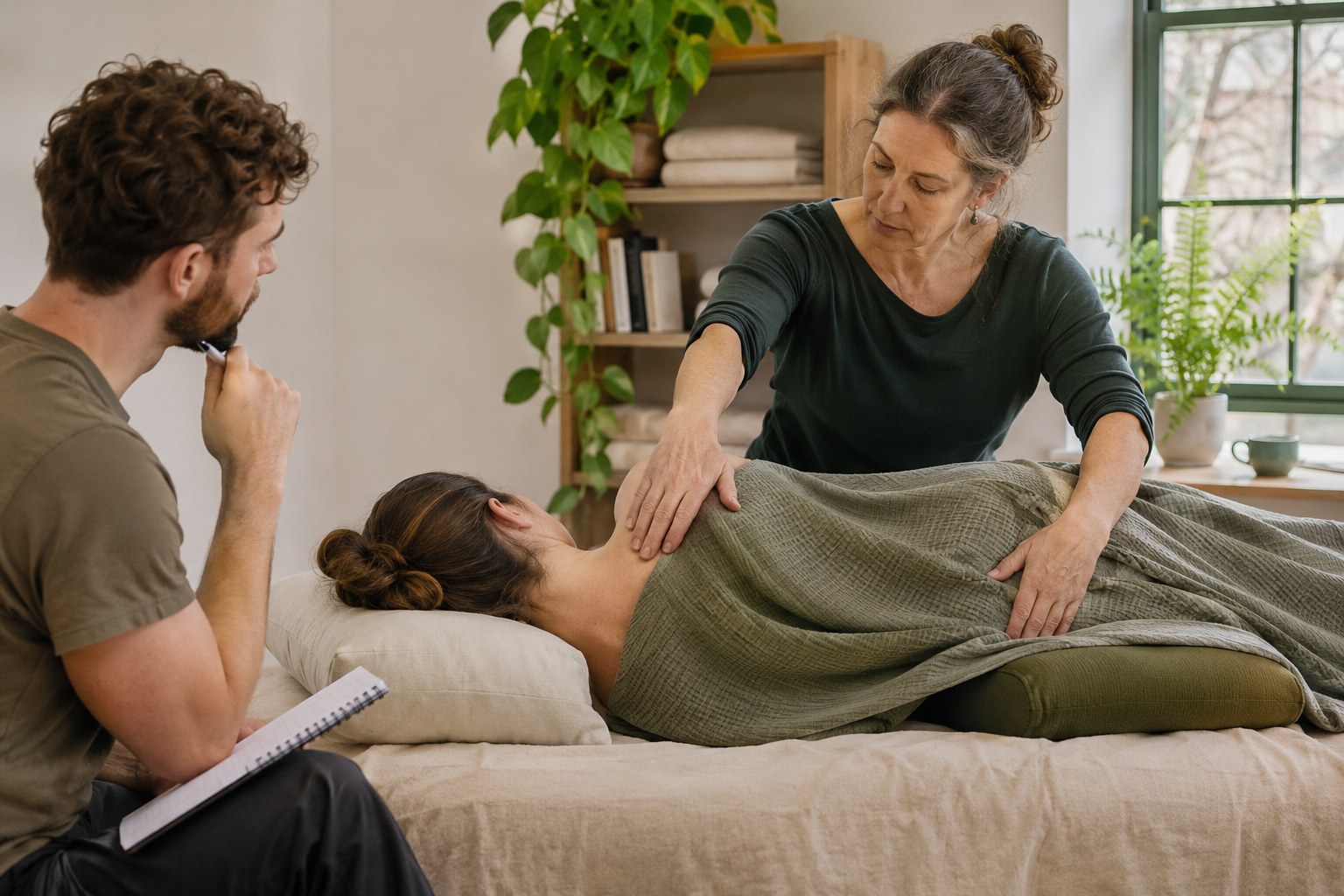
AI-generated editorial illustration for Massage World.